Showing posts with label AIDS. Show all posts

Wednesday, December 2, 2009

THE Quilt - Personalizing AIDS

After reading many of the Bloggers Unite posts for World AIDS Day yesterday, I realized that the personal ones were the most moving. And I was also reminded of the feminist saying of the seventies - "The personal is political."


Although staggering, the statistic of millions of people infected with HIV or having active AIDS is too big and too much to hold in one's mind. I try sometimes to picture millions of people; I can't. The closest I can come is about 500,000 - 1,000,000 in various protests televised from the National Mall in Washington DC. (And some of the largest were for LGBT and women's rights.)

The Quilt, as it is informally known, came about because of activist Cleve Jones in San Francisco:
Since the 1978 assassinations of gay San Francisco Supervisor Harvey Milk and Mayor George Moscone, Jones had helped organize the annual candlelight march honoring these men. While planning the 1985 march, he learned that over 1,000 San Franciscans had been lost to AIDS. He asked each of his fellow marchers to write on placards the names of friends and loved ones who had died of AIDS. At the end of the march, Jones and others stood on ladders taping these placards to the walls of the San Francisco Federal Building. The wall of names looked like a patchwork quilt.
The visual cue was enough to start the NAMES Project Foundation which collected the panels for and constructed the the AIDS Memorial Quilt. The project took off, first around the United States, then around the world.

The Quilt now has 44,000 panels (as of November 2008 and growing monthly), each one 3'x 6', each one a tribute to one individual who has died from AIDS, each one lovingly made by those left to mourn.

The panel I have pictured above for Lewis Anton Smith, whom I do not know, is displayed on the homepage of  aidsquilt.org.  It seemed almost too personal to post the image of the panel - would I be offending the maker of the panel, disrespecting the image?

But the personal, painful, intimate nature of the individual blocks is exactly the point. The statistic of 44,000 people who are commemorated on the Quilt, is another statistic - hard to imagine, really. But to see even one panel invades one's space, says that Lewis Anton Smith, this age, this face, this family, died of AIDS. Now imagine 44,000 of those faces all in one place.
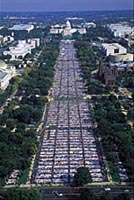


The Quilt is, for me, the most striking, astounding reminder, wake-up call, and dedicated testament anyone has ever made about the tragedy of AIDS.


The Quilt was shown on the National Mall in Washington DC on both the first (1987) and last (1996) time it was shown in its entirety - interesting how that place is so significant, visually, politically, and symbolically.


The Quilt and the NAMES Project Foundation live, now, in Atlanta, Georgia. Parts of the quilt are on display around the United States constantly and may be requested for community and academic events. The Quilt is also searchable online - a good thing, but a sad commentary on the slow progress of eliminating HIV and AIDS.

Tuesday, December 1, 2009

In Memory of Robert H. Dunham, November 12, 1939 - May 18, 1990


There is a Moment in each Day that
Satan cannot find,
Nor can his Watch Fiends find it;
but the industrious find
This Moment & it multiply,
& when it once is found
It renovates every Moment of the Day
if rightly placed.

William Blake - Milton


Dr. Robert Dunham was a professor in the English Department at Simon Fraser University from 1966 until his untimely death from AIDS in 1990. An eloquent and passionately committed teacher, he brought the Romantic poets to life for many students, instilling in them a love of poetry. Because of his dedication to the teaching of literature, he won the SFU Teacher of Excellence Award in 1986, and the prestigious 3M Teaching Fellowship in 1988.
---------------------------------------

Sitting in Rob's class for the first time in January 1987, I remember thinking that there was no place on earth I would rather be than in that room listening to him. He did indeed instill a deeper love of poetry in me and a continuing love of the Romantic poets.

A little later, as a graduate student, I had many opportunities to talk about poetry and life with Rob. As his AIDS progressed, his students gathered around him, initially I'm sure, in some determined attempt to shield him from the disease. Later, when he was nearer death, we spent much time helping with the many mundane tasks of life and talking endlessly about poetry, which seemed to ease his mental pain, at least.

I can never truly express the love and admiration I had for this man. He was so passionate about poetry and teaching, so charming, elegant, and generous. Even today, nearly twenty years after his death, I think of him every time I read or teach poetry. 

There are only a very few individuals who deeply mark one's life. Rob Dunham marked mine.

Today is World AIDS Day, a day to remember all of those lost too young to this terrible affliction, a day to celebrate the advances that lengthen the lives of many, and a time to remind everyone that the fight is not over.

I leave you with one of Rob Dunham's favourite songs - "A Change is Gonna Come," by Sam Cooke. The change involving life-prolonging drugs has come since Rob's death in 1990, but there are still significant changes that we must bring about.


Tuesday, May 6, 2008

A Wise Woman


Elizabeth Pisani is an epidemiologist specializing in infectious disease. She writes about, cares about, and advises about HIV around the globe. Her blog covers things sexual and scientific.

Her book The Wisdom of Whores: Bureaucrats, Brothels, and the Business of Aids (released today) outlines the ways we fail to do what it takes to end the Aids epidemic.

She says that political correctness about sexual practices is killing people.

Agencies and governments don't want to label common sexual practices, especially in Africa - like multiple partners - as bad for fear of offending!

Pisani also concludes that we have to begin thinking of this epidemic as being about sex, and not predominantly about poverty and gender.

Pisani discusses her book in the Times Online. And Alex Renton reviews it in the Times Online. She makes sense, plus she knows several languages and has a degree in Classical Chinese from Oxford and was for a time a correspondent for Reuters. Wise and interesting.

I would like to invite Pisani to my soiree.