Showing posts with label poetry. Show all posts

Wednesday, June 1, 2011

Backlit Glory

One of the few literary arguments my husband and I have is about the poems of Gerard Manley Hopkins. I love Hopkins' "sprung rhythm" and the powerful language that recalls Anglo-Saxon poetry. My husband jokes that teaching Hopkins (which I do often) should be grounds for dismissal, such is his dislike.

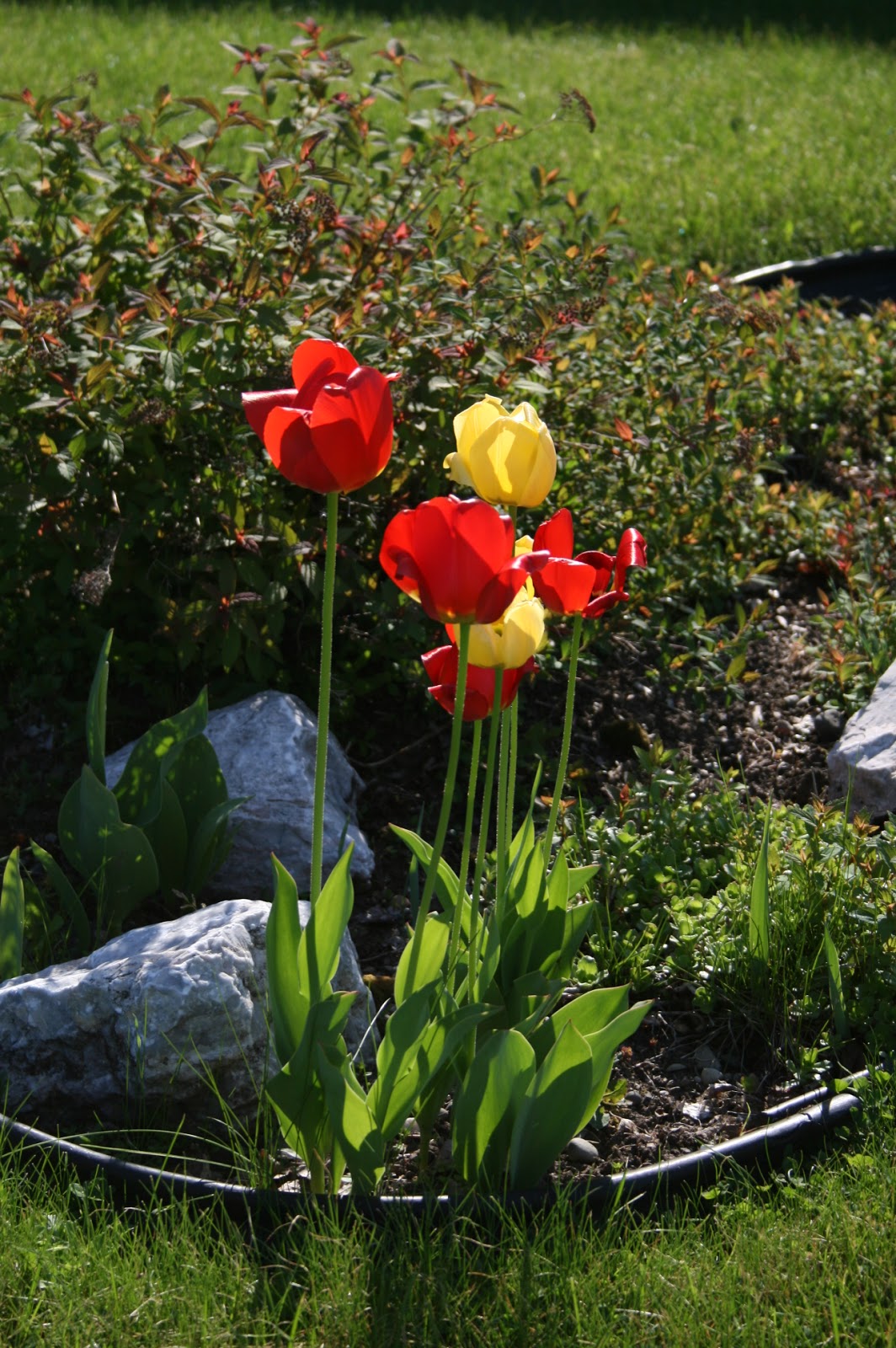
As I drove in the driveway this morning, some tulips in my garden were wonderfully backlit. I just had to take these photos. When I put them up on the computer, lines from Hopkins came to me unbidden from his poem "God's Grandeur":


The world is charged with the grandeur of God.
It will flame out, like the shining from shook foil...


For me, any poet's words that come to mind in the face of such natural spectacle must not be so bad.

Thursday, April 15, 2010

April is Poetry Month

Once upon a time, poetry didn't need a special month set aside for it. But in the millennia since humans first became poetic, what is encompassed by the word "poetry" has become so diverse and often so removed from our everyday lives, that we need a reminder of what poetry gives to us and an opportunity to celebrate it and its makers.

April is poetry month in Canada and in the U.S.

Way, way back, poetry was an aid to memory, the repository for heritage, ancestry, and the lineage of one's cattle. Professional rememberers knew the formulas for oral poetry and could recite the story of a people's creation, battles won and lost, the coming of animals into the world.

At times, poetry has expressly taught us lessons, given us images, told us stories, conveyed ideas, celebrated the sound of words and the sheer joy of putting them together. Poetry expresses the world to us in ways that we don't usually think of for ourselves.

Poetry is also the battleground for academics, poets, theorists, critics, and people whose grandmothers write poetry in notebooks. Everyone, it seems, knows exactly what poetry is and what it definitely should never be.

In fact, many of us have an idea about what constitutes "real" poetry. It can be representational,  or concrete, or imagistic, or rhyming, or not ryhming, or structured, or free. Should one use villanelles or ghazals, isolate syllables with parentheses, use all lower case, spill out angst or joy, celebrate daffodils ? Long line or short? Lyrical or conceptual?

I have taught poetry classes for twenty years, read it for most of my life, and written a little as well. I love poetry in most of its forms, purposes, and concepts, even if I cannot say that I do so equally.

I have come to thoroughly dislike the, often quite bitter, arguments among poets themselves, among academics who advocate for a particular theory above all others, among those who simply don't know the great range of poetry and insist that only what they do know counts.

We humans can take something so integral to our long existence -  a linguistic mode of expression,  joy,  provocation, beauty, sound-  and fight about it to the point that it can become marginalized and we do, indeed, need a special month to commemorate it.

We need rap, and rhyme, and all the other modes of poetry. We need the poetry of professional poets, of children, of grandmothers, of the poets of the past from any tradition.

Crayola is celebrating National Poetry Month with activities for kids. The Poetry Foundation doesn't seem to be in celebration mode, but is such an incredible resource for poetry that I must mention it. Did you know that there are even poems celebrating nutrition month, which was in March? The corporate, the kids, the highbrow, the rhyming nutrition poems, we need them all.

April is Poetry Month. Have a poem for breakfast!


(daffodil photo credit)
(painting by Ann Altman)
Thursday, April 1, 2010

The Chorus of Hallelujahs!

It is always a hard sell to convince students in poetry class that the poet's intention for a poem does not exhaust the range of meanings for that poem. Everyone wants to resurrect Shakespeare and ask him just exactly what he meant in a particular line. (And every student believes his or her interpretation is most likely the same as Shakespeare's!)


We don't do this with songs. We embrace covers of famous songs by the dozens (sometimes radically different interpretations) . Often, songwriters have recorded their own songs, so we have the author's interpretation, which we may really like. But we may also really like a cover, maybe even more than the author's version.

Leonard Cohen's composition "Hallelujah" is one such song. Cohen wrote and recorded the song. If we expect the same from him as we do from other songwriters/poets, we should insist that his recording is the final and best interpretation of the song - he's given it to us in the recording. Actually, he's given it to us in several versions, all slightly different - so what does that mean? Any version is awesome.


The artists who have offered their interpretation of this song are many and varied: Rufus Wainwright, Bon Jovi, John Cale, Jeff Buckley, The OC, Kate Voegele, Celtic Thunder (and apologies to anyone I've missed). Everyone has a favourite.

My all-time favourite is by k.d.lang. For me, the highlight of the opening ceremonies of the 2010 Winter Olympics in Vancouver was k.d. lang singing this song. I am humbled. (Here's the link to the Olympic performance - even if it were possible to embed this video, one would risk death and dismemberment to do so!). Here is a video of another occasion with k.d.lang singing this beautiful song:


I don't know why we make such a distinction between poetry and songs: too strict English teachers; needing the "right" answer for a test; considering poetry to be more high-brow and intellectual than songs; all of the above. (I'm not saying they are the same, just that our approach ignores the similarities.)

My best poetry teacher Rob Dunham said that after hearing some blues music, we don't ask, "What does it mean?"  We listen and experience. We should do the same for poetry before we begin to analyze and interpret. Feel the ryhthm; hear the connotations;  live the experience. Songs can guide us.

 Hallelujah!

Saturday, February 6, 2010

Weird, Wild, Wonderful 4 - Jan 31 - Feb 6

Some new findings, some old favourites.


ThinkShop, a blog on history, politics, and literature (among other interesting and intelligent musings). This blog is very well-written by an educator who lives in Switzerland.


nthposition online magazine is hard to categorize and certainly extensive. Here are the sections, just to give an idea: Strangeness, Politics, Opinion, Places, People, Poetry, Fiction, Reviews, Artreviews, Discussion, Contributors, Links. Good writing; some eye-opening essays.


In These Times, always interesting, always pointed, always good reading:
In These Times is a newsmagazine committed to political and economic democracy and opposed to the dominance of transnational corporations and the tyranny of marketplace values over human values. In These Times is dedicated to reporting the news with the highest journalistic standards; to informing and analyzing movements for social, environmental and economic justice; and to providing an accessible forum for debate about the policies that shape our future.


Delineating Art, the blog of artist Elaine Cheung offers commentary on art and life. Many of her posts begin with a particular artist or piece and then lead out to a larger point. Thoughtful and interesting.

Saturday, January 23, 2010

Weird, Wild, Wonderful 4 - Jan 17-23

My favourites from last week.

Shining History:Medieval Islamic Civilization is a blog of far-ranging information, about architecture, mathematics, philosophy, and more, all about the multitude of contributions, discoveries, and firsts by thinkers and inventors from the medieval Muslim world. Advancements in science and preservation of knowledge in Islamic culture paved the way for the Western European Renaissance and raised the level of civilization between the 5th and 12th centuries. Although scholars have found that the Dark Ages in Catholic Europe may not have been nearly as dark as once thought, there is no question that Europeans were surpassed in sophistication and learning by the Muslim world. This blog is rich in information about the achievements of Islamic civilization.


The poet John Keats is in the news nearly two hundred years after his death with the recent release of the movie Bright Star, the story of the ill-fated love between Keats and Fanny Brawne. There is a comprehensive website dedicated to the life and work of the poet, complete with a newsletter, biographies, and facsimiles of some of the maunscripts of letters and poems. The facsimile of the "Bright Star" sonnet pictured here is from the site.


Allen Ginsberg. "Spiritual seeker, founding member of a major literary movement, champion of human and civil rights, photographer and songwriter, political gadfly, teacher and co-founder of a poetics school, Allen Ginsberg (1926 - 1997) defied simple classification." This site has photos, published and un-published work by the poet, hand-written materials, and then some. A great site for Beat and Ginsberg fans.


Medecins sans frontieres (Doctors Without Borders) has a blog "Haiti Earthquake" and blogs about work on other fronts, plus a photo blog. There aren't many entries (busy saving lives instead of blogging!), but this one is worth a look.


Thursday, January 21, 2010

Ode to the Lemon

The poem is "Ode to the Lemon" by Pablo Neruda (trans. Margaret Sayers Peden).  The photos are mine - making preserved lemons.


From blossoms
released
by the moonlight,
from an
                     aroma of exasperated                       
love,
steeped in fragrance,
yellowness
drifted from the lemon tree,
and from its plantarium
lemons descended to the earth.


Tender yield!
The coasts,
the markets glowed
with light, with
unrefined gold;
we opened
two halves
of a miracle,
congealed acid
trickled
from the hemispheres
of a star,
the most intense liqueur
of nature,
unique, vivid,
concentrated,
born of the cool, fresh
lemon,
of its fragrant house,
its acid, secret symmetry.


Knives                                                                      
sliced a small 

cathedral
in the lemon,
the concealed apse, opened, 
revealed acid stained glass,
drops
oozed topaz,
altars,
cool architecture.


So, when you hold
the hemisphere
of a cut lemon
above your plate,
you spill
a universe of gold,
a
yellow goblet
of miracles,
a fragrant nipple
of the earth's breast,
a ray of light that was made fruit,
the minute fire of a planet.


Sunday, January 3, 2010

Soiree's Past Week

At My Soiree - December 28 - January 2

Ready to go for the new year and saying goodbye to the last of last year's posts. Enjoy!


Faux or No? - December 28/09
Happy New Year - December 31/09
Weird, Wild, Wonderful Four - Dec 27 to Jan 2 - January 2/10


(credit for red door photo)

Saturday, January 2, 2010

Weird, Wild, Wonderful Four - Dec 27 to Jan 2

I'm looking forward to another year of showcasing interesting, incredible blogs and websites.

The blog Women of History features mostly stories about women, past (often medieval) and present and spotlights women's issues around the world. Most posts are quite short and many are excerpts or summaries of other articles with links. The posts are really wide in their range - from Louisa May Alcott to Diane de Poitiers and Cleopatra. I really enjoy this blog for its range, its frequent posts, and its sheer volume of good information (826 posts in 2009!).


The website for the Poetry Foundation has so much to offer and would take several days to fully explore, but what resources they have! "The Poetry Foundation, publisher of Poetry magazine, is an independent literary organization committed to a vigorous presence for poetry in our culture. It exists to discover and celebrate the best poetry and to place it before the largest possible audience." If you love poetry, you'll love this site.


I came across this site for a documentary by Leo Sacks. The film, which is in production, is A Taste of Heaven: The Heartbreak Life of Raymond Myles, Gospel Genius of New Orleans about the life and death of the gay gospel star. His music is amazing, as his life and death story is for the intolerance and homophobia he endured. The site for the film showcases his incredible singing.


Last but not least, a humour blog - something I haven't checked out before. Of Cabbages & Kings is funny and intelligent with lots of interesting literary and cultural references.

Monday, December 28, 2009

Faux or No?

When I was a grad student, one of my colleagues wrote spiritual/religious poetry. She sold much of it to the official publications of various denominations and to small magazines and newsletters of individual churches all over the English-speaking world. For at least a couple of years, she made about $2000 - $3000 a year, a very nice addition to her meager student income!

My colleague was an atheist - staunch, loud, and pushy about it, too - but she could sure write poetry that was popular with devout religious people.

I always share this story with my writing classes as a point of discussion about distinguishing between the writer and the written, the truth and the creation. It generates much heated discussion. The question  is about what exactly writers are selling - their authentic experience and beliefs or words on a page -  and when and why it does and doesn't matter.

The answer depends on the genre and its traditions, which shape the expectations of reader and writer.


In news, we expect the truth, and writers, editors, and producers can be rightly fired for faking it. With news, including "soft" news, the facts are the focus. We often know little about the reporter, and sometimes have no byline at all.  Notwithstanding theoretical discussions about truth or about bias, news traditionally is factual.

At the other end of the spectrum is fiction. Novels and short stories may tell us a truth about human existence; but no one expects them to be the literal truth, nor do we expect the writer to have experienced everything in the work, and we do not expect knowledge about the author.

Other genres are less clear cut and can create problems because of lack of knowledge of the tradition or because of readers' expectations, and in some cases, manipulation by writer and/or publisher - memoir, creative non-fiction, even poetry, in the case of my colleague.

I wrote previously about the fiasco over James Frey's book "A Million Little Pieces." My take on his book is that it is memoir and has a narrator who is different from the living, breathing author. That suggests a certain shifting ratio between fact and fiction, which is the tradition of memoir.

I also think that people were justly outraged because the living breathing author appeared on the Oprah show, claiming that he and his narrator were identical with identical experiences.

So, what about my fellow grad student's religious poetry? No one ever asked about her religious beliefs or about any religious affiliation. Everyone accepted the poetry she offered, the words on the page. Several bought her poetry more than once, saying that their readers had especially liked it. One publication asked her to submit more.

I think that people made assumptions about her and about her beliefs and would not have published her poetry if they had known that she was an atheist. But they also proved a point about certain genres and expectations for fact and for knowledge about the writer. The poems she submitted said what they said; they were true as written expression of certain religious sentiment. They were not true expressions of her belief, and she never offered them as such.

Faux, or no? What do you think?

Wednesday, September 2, 2009

Inviting Writer

Lola Lemire Tostevin is a Canadian writer (in both French and English) of fiction, poetry and criticism. She taught at York University in Toronto, where she now lives.


I met Tostevin at Simon Fraser University in Burnaby, Canada. She was writer in residence for one week in the hot summer of 1990. I was a graduate student doing a course in contemporary Canadian literature, and Tostevin shared her work and her thoughts, both at the university and at off-campus social events.


My most vivid memory is of Tostevin reading "Le Baisir de Juan-Les-Pins," part of her in-progress novel Frog Moon (1993).

We sat in a room next to a courtyard, with doors open, hoping for even the smallest breeze. Tostevin began to read and, after a very short time, the room was pin-drop silent, as we forgot the heat and were transfixed by the story and her quiet, but dramatic reading style.
 
Off campus, we congregated at a small backyard cottage rented by one of the other grad students. The conversation and the wine flowed in the evening heat. Tostevin shared her ideas on literature and feminism, and her advice for would be writers.
 
Tostevin was fun, talented, and generous with her time, her work, and her advice.
 
I would like to invite Lola Tostevin to my soiree.

Wednesday, August 19, 2009

Writer for the Rest of Us.


Although I like his writing, I also appreciate Ishmael Reed  as an editor and publisher.

The poetry anthology From Totems to Hip-Hop: a Multicultural Anthology of Poetry Across the Americas, 1900-2002 is welcome relief from the usual anthologies and concept texts for teaching poetry. Much of the content, especially the mainfestos, captured the attention of a first-year poetry class expecting the usual.

The anthology includes work from generally marginalized writers from many races and cultures, and in doing so presents not only diverse views but diverse forms.

I loved teaching with Reed's book and will continue to use it.

Ishmael Reed's Konch Magazine is another welcome relief from much of the usual mainstream news, views, writing. In Reed's own words about the publication:

"While the American media, progressive, mainstream, corporate and alternative literary magazines, book reviews, etc. continue to publish writers and poets from the same background and values Konch will continue publishing writers from the world over who address the important issues of our time. We will continue to publish poets who have something to say.
Konch is a publication for the rest of us."

The "rest of us" are grateful for the poetry anthology and the magazine.

I would like to invite Ishmael Reed to my soiree.

Saturday, August 15, 2009

Cursing Silence

I first learned of Linda McCarriston in Bill Moyers' film series The Language of Life: A Festival of Poets that I showed to a first-year literature class. I was awed by her poetry, especially the work she read from her 1991 book Eva-Mary.

Many of the poems in Eva-Mary deal with McCarriston's cruel and violent childhood with a father who beat her and her brother, and sexually abused and assaulted both McCarriston and her mother.

In these poems, McCarriston, with pointed and precise language, transfixes the reader, as her gaze does not waver from the brutal scenes of her past.

My earlier post -Voice of Silence - reminded me of McCarriston's poetry, especially the poem "To Judge Faolin, Dead Long Enough: A Summons" from Eva-Mary. McCarriston summons the spirit of the judge who sent her mother back to her violently abusive husband. He would not hear the agony of the woman appealing to him. In short, he gave her testimony little weight when set against the preservation of the family and the law.

In her interview with Bill Moyers, McCarriston says that this poem is an example of "flinging the curse."

Reminds me of Solnit's curse on Mr. Very Important II and my borrowing of it to curse Mr. Justice Douglas Cunningham - To Judge Faolin: "a carbuncle on the face of humanity and an obstacle to civilization".


I would like to invite Linda McCarriston to my soiree.